Yesterday was the third day of sixth grade. Each of those three days, when I pick you up from school, you have had not a frown, not a smile, but a very blasé expression on your face. If the look on your face were a sound it would be monotone. You greet me stoically, and when I ask the obligatory, “so how’d it go today?” your stock answer, these past three days has been, “fine.” I despise the word fine. It is tepid, and shallow, and useless.
We walk around to the other side of the school to gather your sister, who is smiling and bounds up the sidewalk to greet us. She has stories to tell about her new teacher, her new friends, and the experiments she is working on in science. She is beaming.
Once home, you extract a multi-page math homework packet from your bulging, ridiculously overstuffed backpack and tell me it’s due on Monday. I can feel my heart start to race immediately and I begin to sweat. I take the packet from you, and turn to the last page. There are 29 problems, and the last problem has three parts. I flip through the other pages and see there are more problems that have several parts. Many questions come to mind. How long is this going to take? Should I cancel all our weekend plans? When does your father come back from his business trip?
“I need help,” you say. “Well,” I say, “do what you can on your own and then if you need me I will help.” I try to give the worksheet packet back but you don’t lift a finger to receive it. You aren’t thrilled with my response. What you want is for me to walk through each problem, explaining every step as I go, but I refuse.
Honestly I don’t remember much about math. I don’t remember how to multiply mixed numbers, or what the order of operations is, or even how to round to the nearest hundredth. It’s not that I can’t do it. I just need a minute. I need to think about it. I may need to consult the internet. But there’s no way I can just jump right in.
It’s a depressing thought, not being able to readily solve these sixth grade math problems. Actually they aren’t even sixth grade problems. It’s a review of fifth grade problems. I feel stupid and ineffective as a parent. I question how I graduated from high school. In order to prop myself up I remind myself that I was a pretty decent student, save for math. Math dragged me down, prevented me from being on the honor roll, despite doing well in all my non-math honors and AP classes over the years.
It makes me cringe to this day. I suppose I’m mad at myself for not trying harder, or for not seeking help while I was in school. I guess my thinking at the time was well, this is the way it is, I have an issue with math, and nobody is good at everything. In retrospect I know there were several things I could have done to help myself. But for whatever reason it didn’t seem that important. And up until this point, I’ve gotten through my life without having to care a bit about exponents.
“I need help, mommy. I don’t remember how to do any of this.” You don’t remember ANY of this from fifth grade? Nothing? I repeated the mantra about trying on your own first, and then I’d step in. “Skip what you don’t know, we’ll work on it later.” I knew instinctively, from past experience, that this was not going to go well.
Exasperated, you picked up the walking stick we kept by the front door and started dragging it around the living room, leaving a zig zag depression in the Persian rug. I refrained from yelling and gently asked you to not run the stick across the rug. So you started dragging it across the wood floors instead.
“You never help me,” you whined. I just smiled and said “that isn’t true.” It went on like this for half an hour. There were tears and fits of anger, pillows were thrown, pencils were broken. You told me you hated me and that if you had to choose a parent you would choose daddy. I really didn’t take any of it seriously. I didn’t react much at all, expect to warn you that you may lose your phone privileges again, which I’m sure enraged you further.
At some point I sat down next to you on the couch and played an online video about order of operations. As I watched, you pretended not to notice. Instead you kept banging the walking stick on the floor, groaning at the voice in the video, “God, just shut up.” “Ugh, I hate your stupid voice.” “This isn’t helping at all.” But it did help and the things you thought you forgot started to come back to you. And me.
After watching a couple of videos, and solving a few problems, It was time to get ready for bed. But there was so much more to do, so many more problems to solve. “You can do more tomorrow” I said. You reluctantly made your way upstairs, carrying the walking stick with you, and sat in the middle of the hallway staring at the stick as it lay on the floor.
The walking stick was fashioned from a large branch you found during a hike in the woods about a year ago. You asked if you could bring it home, and your dad used his small pick axe to whittle it into a sort of walking stick. As you stared at the stick at your feet, I could tell something was brewing. Was it guilt? Forgiveness? Resilience? Please please let it be resilience. There, I left you to your thoughts.
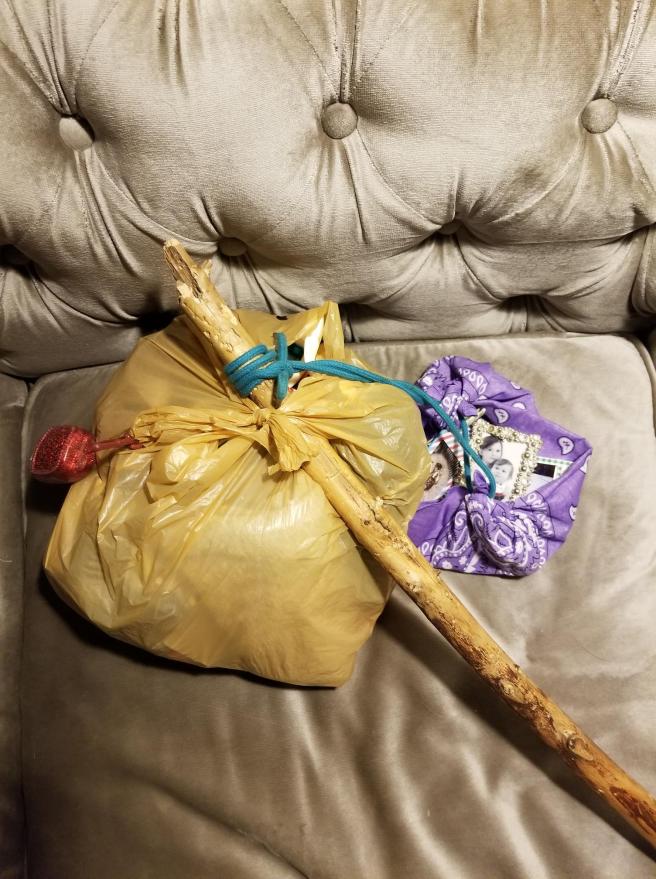
Half an hour later you pushed open the door to your sister’s bedroom where she and I were reading together and declared, “I’m leaving. I don’t want to live like this anymore.” The walking stick rested on your shoulder and at the end you had tied a purple bandana, which was folded in such a way as to form a cloth bowl, and using a piece of old yarn, you tied the bandana to the stick.
You didn’t seem angry. In fact you had a little smile on your face. The first smile I had seen since school started. I could tell you were just fishing for my reaction, and perhaps looking for acknowledgement that you had in fact thought this through quite well, and were fully prepared and equipped to run away from home and start a new life on your own.
Your sister and I followed you downstairs and as I surveyed what you had packed in the bandana: one photo each of your grandmother, the dog, and one with you and your sister, taken at a photo studio seven years earlier, both of you dressed in elaborate Christmas dresses all red plaid and silk bows. Along with the photos you added a dollar bill.
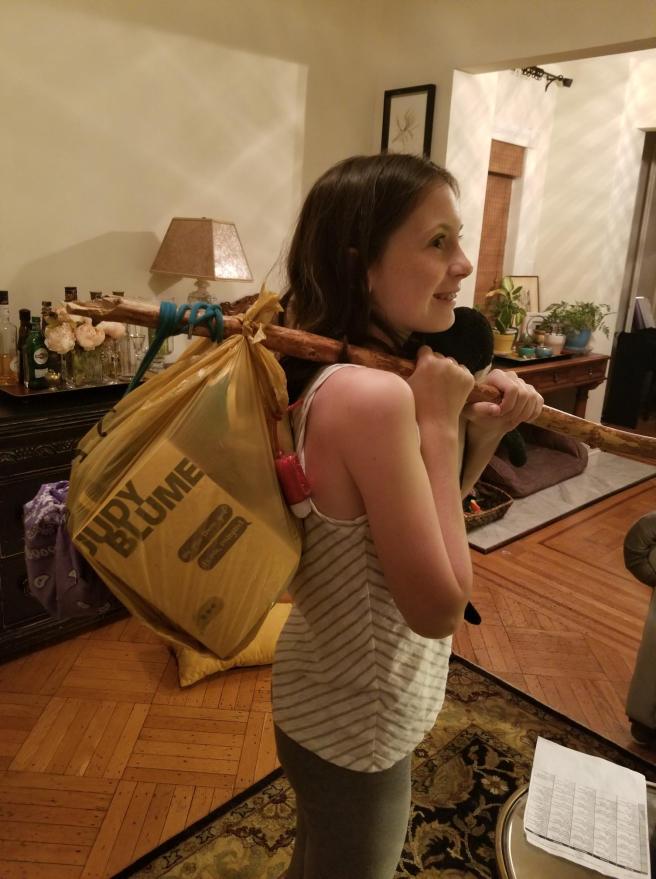
Not everything you wanted to bring fit into the bandana bowl so you tied a plastic shopping bag to the walking stick which held the rest of your supplies: a change of clothes, bathing suit and goggles, and the book Are you There God? It’s me, Margaret. The final bit of luggage you packed was a small bottle of hand sanitizer which you left strapped to the end of the stick, closest to your shoulder, as one would, for easy access. But the pièce de résistance was the greying stuffed whale that your father had bought for you several years ago. Whistle the Whale. You carried him in the crook of your left arm while the walking stick rested on your right shoulder. I thought to myself this kid has grace. She wouldn’t last a hot minute on the streets of Jersey City but god damnit I love her for packing this mish mosh of sentimental tween booty.
“We need a picture of this,” I declare, “I may never see you again.” Then, staring at your bare feet I calmly stated, “you’ll want to wear your shoes. Sneakers are best.” You’re really smiling now, voice lilting, telling me, “yeah mommy I know. I was going to put my sneakers on. And you’re right, mommy. You probably won’t see me again.”
I want to remove the good things you packed in the bandana and stuff it instead with all the fear and anxiety we have, combined, over math, over rules and obligations, over underachieving and overanalyzing, over tomorrow and the next day, and the day after that and next year. I want to throw in the snark and the sneer, the walls you are building around me and the control I try to preserve as your mother.
We can pack the walking stick and bandana up in the car and drive down to the Hudson River. We’ll look at each other and giggle as we exit the car, grabbing the stick by each end as we walk towards the river. We can make a game out of it, Aubrey, you know the game, how daddy and I used to swing you and your sister by the hands, me on one side, dad on the other, swinging you back and forth, one, two, swinging the stick higher and higher and on three we can throw it in the river together, in unison.
That walking stick that’s been sitting idle by the door, waiting to be useful. We can take it on a journey, its final journey, attached to it the shiftless, toxic purple bandana cargo. Let’s watch it drown together. We’ll hold hands, our heads thrown back towards the limitless night sky, and howl with laughter, as the bandana swirls and sinks under the current until it is no longer visible to anyone.
 daelinrie.com